Airbnb vs Vrbo: Which is Best for Hosts?

Airbnb and Vrbo both help hosts attract bookings, but they cater to different travelers and property types. This comparison breaks down the key differences in fees, audiences, features, and earning potential to help you choose the right platform.
Key Takeaways
- Vrbo only allows the rental of entire properties, for example beach houses and city apartments.
- Airbnb is known for offering unique, less traditional properties like yurts, tiny houses, and treehouses.
- Vrbo, which is better for families, has a stronger presence in North America and Europe.
- Airbnb, which is more popular among younger travelers, has a solid global presence, but because of this it can be more difficult for your property to stand out.
- If you list an entire place, the best approach is to list on Airbnb and Vrbo.
Sites like Airbnb and Vrbo offer property owners an opportunity to start a short-term rental business. To Airbnb or Vrbo, that’s the question that many owners ask, though. But what if it doesn’t have to be an either-or situation?
At first glance, Airbnb and Vrbo have a lot in common. While both vacation rental sites were designed as an alternative to accommodations like hotel rooms, there are a couple of differences that a host will need to keep in mind.
Airbnb might be a lot newer than Vrbo, but it has quickly become a popular vacation rental site, especially among younger travelers specifically looking for budget-friendly unique stays or shared spaces. By contrast, Vrbo allows only listings where guests have the entire place to themselves. Because of this, Vrbo properties tend to be more attractive for larger families who are traveling together.
Read on for an in-depth look at which of these two sites would be a smarter choice for starting and growing a vacation rental business. We’ve compared Airbnb and Vrbo and researched their key features, differences, pros, and cons.
Key Airbnb and Vrbo Differences
To help you quickly decide whether Airbnb or Vrbo will make more sense for your vacation rental, here are the main differences summarized:
Airbnb | Vrbo | |
Property Types | Offers a wider selection of properties to guests (unique properties and room rentals are also allowed) | Entire properties only, with a a focus more on traditional types of accommodation |
Guest audience | Broader demographic, including solo travelers, couples, and budget-conscious travelers | Primarily attracts families and groups |
Market reach | Larger global base | Strong in North America and Europe |
Length of stay | More popular for short stays (typically about 3 nights) | More popular for longer stays (7+ nights) |
Airbnb vs Vrbo: General Facts and Figures
Airbnb was officially founded in 2008. As of May 2026, it boasts more than 9 million active listings in over 220 countries, according to its website.
By contrast, Vrbo (originally known as Vacation Rental by Owner) has significantly fewer listings (around 2 million, according to its website), even though the Vrbo story started in 1995 already. Also, unlike Airbnb’s history that’s filled with several acquisitions, Vrbo has already been acquired twice. The first acquisition was in 2006 by HomeAway and, again, in 2025 by Expedia Group.
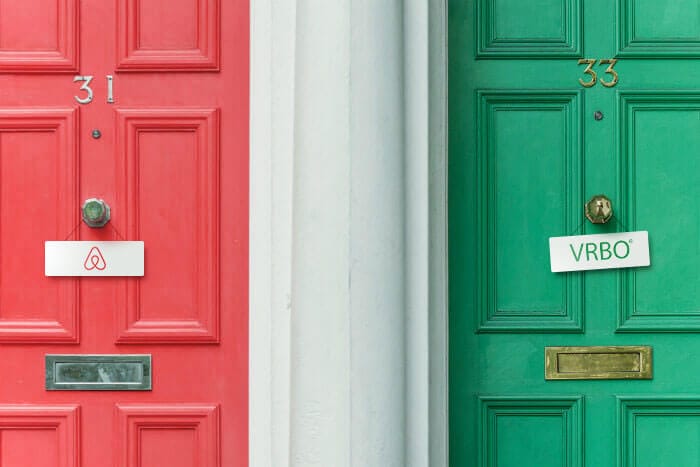
Airbnb vs Vrbo: Property Types
On Airbnb, property owners are allowed to list various types of properties, starting from private rooms to hotel rooms to cabins and tiny houses to luxury rentals and beachfront cottages. In addition, Airbnb allows hosts to list shared spaces. This means that travelers can book single rooms within a home instead of paying for an entire property and easily find more unique accommodation.
On the other hand, Vrbo offers more traditional accommodation. It only accepts bookings for standalone vacation homes and doesn’t allow advertising shared spaces of any kind. That said, bed and breakfasts are allowed but will first be subject to review.
Although both Vrbo and Airbnb provide short-term rental accommodations, Vrbo properties are more suited for longer stays. Airbnb is a great option for those taking shorter trips, but, that said, this platform introduced monthly stays and now offers discounted prices for longer stays.
Vrbo vs Airbnb: Types of Travelers
Airbnb attracts people of a younger age who are in search of more affordable accommodation. It also lures adventurers who are craving a trip with new experiences as opposed to the typical hotel stay.
As for the length of stay, Airbnb tends to attract travelers looking to rent a property for a shorter term at an affordable price in city destinations. As such, it also caters to business travelers who are looking for convenient accommodations.
By contrast, Vrbo rentals are famous for family vacations and older audiences who are willing to pay for an entire apartment or house. Plus, according to its website, compared to a platform like Airbnb, Vrbo guests typically stay longer.
Airbnb vs Vrbo: Service Fees

No matter where you decide to list your property, there are fees to be paid by both hosts and guests. Service fees can affect your overall short-term rental revenue and the final price a guest will pay for a reservation.
Here’s a quick breakdown of how the main fees compare across the two platforms:
The cost of listing on Airbnb
Airbnb offers two different service fee options: The split fee and the single fee. That said, the single fee is mandatory for hotels, serviced apartments, and software-connected hosts.
The split fee, as the name suggests, splits the service fee between the guest and host. Under this model, guests typically will absorb the bulk of the fees, usually paying about 14% of the booking subtotal as an additional fee. In this case, hosts end up paying around 3% of the total booking cost.
With the single fee, hosts pay the entire service fee to Airbnb, sparing those who book with them from having to cover a guest service fee. Usually, this amounts to between 14-16% of the total booking cost.
If you opt to offer an Airbnb Experience, you can expect to pay even more. Each Airbnb property owner who offers Airbnb Experiences is charged a 20% service fee.
Pro Tip: The benefit of the single fee is that guests are not blindsided by the additional service fees which are only applied at checkout. To be able to cover the single fee, hosts always have the option to bump up their vacation rental pricing slightly. This way, guests are already aware of the full price and are willing to pay it without feeling scammed.
The cost of listing on Vrbo
Vrbo is slightly more affordable than Airbnb. With its pay-per-booking fee structure, hosts are charged a 5% commission on the rental amount and any extra Vrbo fees (like a cleaning fee) plus a 3% credit card processing fee.
Similarly to Airbnb, hosts who use a property management software (PMS) will pay slightly more. Depending on the location of your vacation rentals, the booking fee can range from 5% to 15%.
Travelers also pay between 6% to 12% as a guest service fee of the total reservation cost when making a booking.
Vrbo vs Airbnb: Cancellation Policy
Both Airbnb and Vrbo have cancellation policies that protect hosts from unexpected cancellations while offering guests refunds for timely notifications.
Airbnb offers the following types of cancellation policies:
- Flexible
- Moderate
- Limited
- Firm
- Strict
- Super strict 30 days
- Super strict 60 days
The three types of strict policies are only available to certain hosts.
Vrbo offers five types of cancellation policies that hosts can set for their listings:
- Relaxed
- Moderate
- Firm
- Strict
- No Refund
Some of these options allow for a refund for guests, while others do not. For example, Vrbo’s relaxed policy (the one it recommends) allows guests to cancel a reservation no later than 14 days before check-in to receive a full refund.
Vrbo also offers a safeguard to reduce unnecessary cancellations. Depending on a host’s reason for canceling, hosts might qualify for a Vbro cancellation waiver. It’s important to note that if you don’t receive a waiver, your ranking metrics will be negatively affected by your cancellation.Vrbo
Vrbo vs Airbnb: Booking Process
Both sites offer similar booking features, including an instant booking feature. This makes the reservation booking process infinitely more convenient for guests, eliminating the need to send a booking request and wait for approval from the owner.
Hosts can also benefit. For example, by enabling Vrbo Instant Booking, your property will also appear to travelers browsing other Expedia Group sites, increasing your exposure.
With Airbnb’s Instant Book turned on, hosts can also improve their visibility. This is because it helps to improve your response rate which in turn boosts your property’s ranking in its search results.
Vrbo vs Airbnb: Quality of Customer Service
Both booking sites have the challenge of catering to the needs of hosts as well as guests. However, all in all, Vrbo generally wins the race in this department. The fact that there are fewer listings on its website might play a contributing factor.
Hosts or guests who need help can contact Vrbo Customer Support. It is available 24/7 via telephone or online chat.
Like Vrbo, hosts can also contact Airbnb via phone or chat.
Then, to improve customer service, Airbnb introduced a Resolution Center that hosts can use to request money or guests can use to request a refund. If guests and hosts can’t reach an agreement, they have the option to ask Airbnb for mediation. A dedicated team member will then assess the information shared by both parties and reach a final decision.

Vrbo vs Airbnb: Reviews
While reviews matter on both platforms, Vrbo and Airbnb approach it quite differently.
Airbnb facilitates the review culture and encourages guests to leave reviews after their stay. A guest and a host have 14 days to write a review. The Airbnb review system is based on a five-star rating and prompts guests to rate:
- The accuracy of the listing description
- Cleanliness
- Communication
- Location
- Check-in
- Value for money
With Vrbo reviews, a guest or a host has up to six months from the date of a stay to leave a review.
Vrbo vs Airbnb: Special Features Worth Mentioning
On Airbnb, in addition to short-term rentals, guests can book unique experiences in some of the world’s most beautiful cities and popular tourist destinations using Airbnb Experiences.
Airbnb Experiences include one-of-a-kind activities specific to a destination that guests may enjoy. For example, guests can book a cooking masterclass with a local host or go on an adventure with a local guide to discover hidden wonders and places of that specific destination. This makes for a completely unique and immersive experience for travelers.
Vrbo’s competitive edge lies in some of the extra functionality on its site. They offer a Trip Board feature, which helps travelers organize their favorite destinations and properties while they are planning their trips. Guests are even able to invite friends and family to collaborate on the boards and search for properties with them if they are planning a trip together.
What Is the Best Vacation Rental Site to Use as a Host?
Your choice of short-term rental platform will be based on the target guest you have in mind and the type of property you offer. Airbnb typically attracts younger travelers who are looking for more affordable short-term rentals. By contrast, Vrbo caters more to families that are searching for an entire house.
If you are lucky to be able to rent out an entire place, you can improve your reach by advertising your property on Airbnb and Vrbo. This boosts your property’s occupancy rate and will help to maximize your revenue.
Once you start harnessing the advantages of multiple vacation rental sites, go one step further, and optimize the process by using the powerful tools provided by iGMS. In fact, it’s highly recommended as you can rest assured knowing that both calendars on Airbnb and Vrbo are in sync at all times.
FAQs
What are the downsides of listing on Airbnb?
Compared to Vrbo, some of the negatives of listing your property on Airbnb are:
- More competition for rental homes in many markets
- Sometimes you need to put more effort in to stand out among numerous listings
- Airbnb is sometimes accused by the host community of siding with guests (although they insist on catering to both parties)
- Risk of problematic guests due to sometimes lower barriers to booking
What are the downsides of listing on Vrbo?
Compared to Airbnb, some of the negatives of listing your vacation rentals on Vrbo are:
- Smaller user base
- May only rent out an entire place
- More focus on family/group travel
- Less name recognition in some markets
- Less demand for urban/apartment rentals (more focused on vacation rentals)
Is Airbnb or Vrbo better for families or large groups?
Of the two platforms, Vrbo is more suitable for families and larger groups because it only allows hosts to list an entire house. This ensures enough space and privacy for all the guests.